
Before you act on an AI answer, CrossCover it.
Independently check the evidence, assumptions, and uncertainty behind clinical AI output before you make the final call.
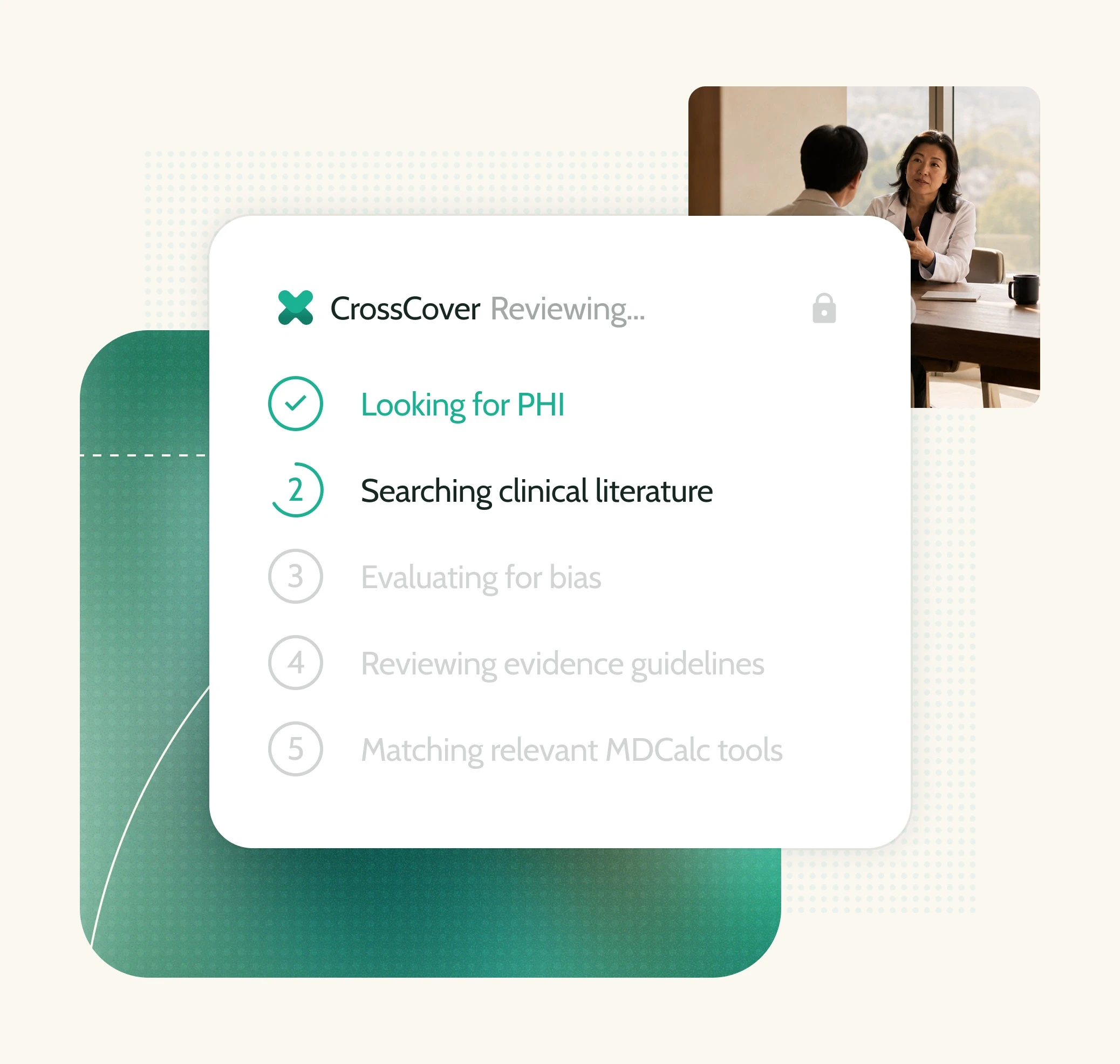
How CrossCover works
- 1
Use the Clinical AI You Want
CrossCover works across clinical AI tools, adding an independent layer of safeguards without locking clinicians into a single model or platform.
- 2
CrossCover Checks the Answer
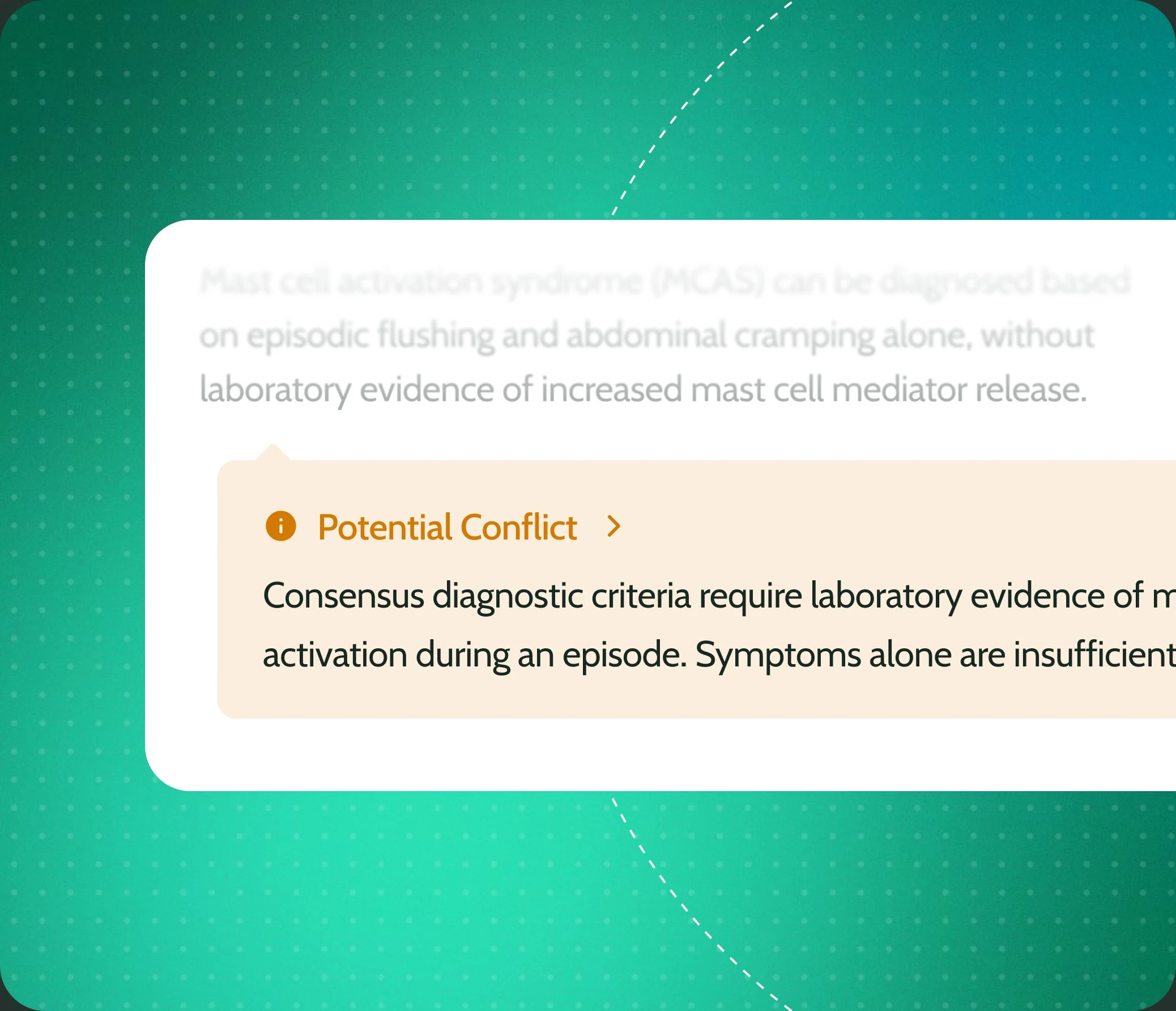
CrossCover independently reviews clinical AI statements and compares them to trusted medical evidence, like guidelines or textbooks. We surface the evidence, assumptions, and uncertainty that deserve your attention.
- 3
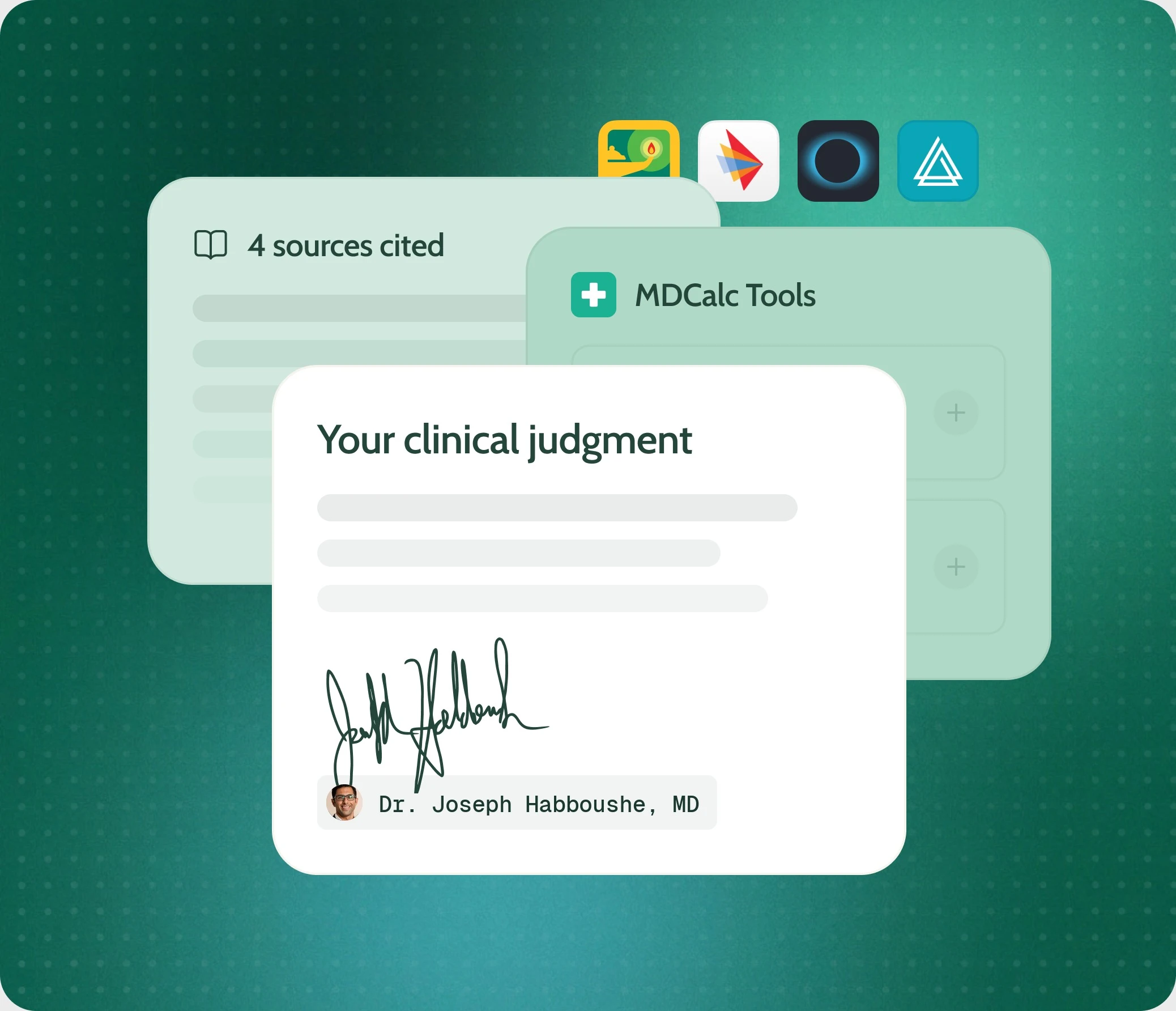
You Make the Final Call
CrossCover doesn’t replace clinical judgment. It gives physicians another layer of information to consider before deciding what to do next.



Safeguards built around every AI interaction
CrossCover runs independent checks throughout the workflow, helping physicians see what deserves a closer look before they make the final call.
PHI Scrubbing detects potential identifying patient information and recommends redaction before your query is sent to an AI model.
CrossCheck independently checks AI-generated information against trusted medical references, surfacing where the evidence agrees, where it differs, and where you may want to take another look.
TrackerBlocking limits unnecessary information about you — such as identity, practice setting, or other context — before your query reaches a partner AI model, helping reduce the potential for irrelevant or commercial factors that could influence its response.
When a clinical question may call for an evidence-based clinical tool, CrossCover can surface the appropriate MDCalc tool directly in the workflow, bringing deterministic clinical calculations into a generative AI experience.
Collaborating with leading AI companies across healthcare
CrossCover is designed to work across the clinical AI ecosystem. We collaborate with AI companies, health systems, clinical organizations, medical publishers, and researchers working to shape the future of clinical AI.
Founded in 2012 by doctors, for doctors, AMBOSS consists of over 100 staff physicians working alongside engineers and designers with one goal: optimizing how medical evidence reaches busy clinicians. AMBOSS Clinical AI is ranked #1 in safety and completeness in both Stanford-Harvard NOHARM studies.
Vera is the leading medical search engine that finds, grades and cites the best available evidence in seconds, used by more than 800,000 clinicians. When you type a question, Vera instantly searches more than 60 million peer-reviewed papers, medical guidelines, drug references, and real-world care pathways.
ECRI is an independent, nonprofit organization improving the safety, quality, and cost-effectiveness of care across all healthcare settings.
The American College of Physicians is the largest medical specialty organization in the United States with members in more than 172 countries worldwide.
FAQ
What is CrossCover by MDCalc?
CrossCover is the safety layer for clinical AI. It works alongside the AI tools clinicians use, independently checking their output and surfacing evidence, assumptions, and uncertainty before a physician makes the final call.
Is CrossCover a large language model or an AI chatbot?
No. CrossCover isn’t another LLM. It’s designed to work alongside the top clinical AI models and add independent safeguards around their output.
Why does clinical AI need an independent safety layer?
AI can produce convincing clinical answers while still missing important evidence, make hidden assumptions, or express uncertainty poorly. CrossCover adds an independent layer of checks outside the underlying AI model so clinicians have another source of information before acting.
Why shouldn’t I just use an AI tool directly?
You can. CrossCover is designed to add another set of eyes when you use AI for clinical questions. It independently checks parts of the output against medical evidence, adds privacy safeguards, and surfaces areas that may deserve a closer look before you make the final call.
Why does CrossCover remove information about the clinician?
There is a surprising amount of information about physicians available online — where you practice, your specialty, your prescribing patterns, and more. Much of this is actively bought and sold online. CrossCover’s TrackerBlocking is designed to limit information that isn’t clinically relevant from influencing AI responses.
The goal is simple: clinical recommendations should be based on the clinical question and the needs of the patient, never who is asking the question, which insurance the patient has, or any other factors irrelevant to the clinical need.
If my health system already has an AI tool, why would it need CrossCover?
CrossCover isn’t intended to replace the AI tools a health system has already chosen. It’s designed to work alongside them.
Different models have different strengths, limitations, and safeguards. CrossCover adds an independent layer of clinical checks that can remain consistent across the AI tools clinicians use.
How does CrossCover make money?
CrossCover is currently free for eligible healthcare professionals. Over time, we expect advertising to help support the platform, as it does with MDCalc.
We draw a clear line between advertising and clinical information: Just as advertising does not influence the output of an MDCalc tool, commercial relationships will not determine the clinical answers, evidence, or recommendations a physician sees on CrossCover.
How is CrossCheck different from an AI model citing its own sources?
CrossCheck, currently in beta, is independent of the model generating the original answer. It reviews the output against authoritative medical references and surfaces where the evidence supports the response, where it may be more nuanced, and where something deserves another look.
Think of it as a second set of eyes — not another answer you have to blindly trust.
Aren’t AI outputs getting better with fewer hallucinations?
Yes — and we hope they keep getting better. But hallucinations are only one reason clinical AI deserves scrutiny.
An answer can be factually accurate and still miss an important exception, make an assumption from incomplete information, overstate the evidence, or apply the right information to the wrong patient. CrossCover is designed to surface those moments, not simply catch invented facts.
Who can use CrossCover?
CrossCover is currently available free of charge to eligible healthcare professionals and supervised medical trainees residing and working in the United States.